The Ultimate Guide to DnD Dice Rolling
By Arthur D Masters & Tia
Dice rolling is the heartbeat of Dungeons & Dragons. It's the moment of tension, the spark of randomness that makes every session unique. Whether you're a brand new player or a grizzled veteran, understanding the nuances of dice rolling can elevate your game.
The Sacred Geometry: Understanding Your Dice
DnD uses several types of dice, each with its own purpose and mystique:
The d4 (Tetrahedron)
Sides: 4 Common Uses:
- Low damage weapons (daggers, darts)
- Healing spells (Healing Word)
- Divine guidance (Bless, Guidance)
The Truth: Often called the "caltrop" for its tendency to hurt when stepped on. The d4 is notorious for taking forever to settle and always landing on the most inconvenient number.
The d6 (Cube)
<div align="center"> <img src="/svgs/d6.svg" alt="d6 dice" style="width: 80px; height: 80px; margin: 20px auto; display: block;" /> </div>Sides: 6 Common Uses:
- Weapon damage (shortswords, shortbows)
- Sneak attack damage
- Fireball damage
- Most traditional "board game" applications
The Truth: The most familiar die in gaming. Six-sided dice have been used for millennia and feel instinctively "fair" to most players.
The d8 (Octahedron)
<div align="center"> <img src="/svgs/d8.svg" alt="d8 dice" style="width: 80px; height: 80px; margin: 20px auto; display: block;" /> </div>Sides: 8 Common Uses:
- Medium weapon damage (longswords, battleaxes)
- Healing spells (Cure Wounds)
- Cantrips at higher levels
The Truth: The workhorse of DnD dice. Not too swingy, not too boring. The d8 is the Goldilocks of polyhedral dice.
The d10 (Pentagonal Trapezohedron)
<div align="center"> <img src="/svgs/d10.svg" alt="d10 dice" style="width: 80px; height: 80px; margin: 20px auto; display: block;" /> </div>Sides: 10 Common Uses:
- Large weapon damage (heavy crossbow)
- Percentile rolls (paired with another d10)
- Specific spells and abilities
The Truth: The d10 is unique in that it's numbered 0-9 or 1-10 depending on the die. Two d10s make a d100, the ultimate "swing for the fences" die roll.
The d12 (Dodecahedron)
<div align="center"> <img src="/svgs/d12.svg" alt="d12 dice" style="width: 80px; height: 80px; margin: 20px auto; display: block;" /> </div>Sides: 12 Common Uses:
- Great weapon damage (greataxe)
- Barbarian class features
- A handful of spells
The Truth: The "forgotten die." Many players joke that the d12 is the least-used die in their collection. Barbarians and greataxe fans, however, treasure their d12s.
The d20 (Icosahedron)
<div align="center"> <img src="/svgs/d20.svg" alt="d20 dice" style="width: 100px; height: 100px; margin: 20px auto; display: block;" /> </div>Sides: 20 Common Uses:
- Attack rolls
- Saving throws
- Ability checks
- Death saves
The Truth: The KING of DnD dice. The d20 determines success and failure for almost every important action in the game. Rolling a natural 20 (critical hit) or natural 1 (critical fail) are the most memorable moments in any session.
The d100 (Percentile Dice)
Sides: 100 Common Uses:
- Random tables
- Wild magic surges
- Certain magical items
- Loot determination
The Truth: Not a physical die (usually), but rather two d10s rolled together. One represents tens, the other ones. A 00 and 0 is typically read as 100.
Core Mechanics: The d20 System
DnD 5th Edition revolves around the d20. Here's the basic formula:
d20 + Modifier vs. Target Number
Components:
- The Roll: 1d20
- The Modifier: Relevant ability modifier + proficiency bonus (if applicable) + situational modifiers
- The Target: Armor Class (AC) for attacks, Difficulty Class (DC) for checks and saves
Example:
A fighter with +5 Strength and +3 proficiency attacks a goblin with AC 15:
- Roll: 10 (on the d20)
- Modifier: +5 (STR) +3 (proficiency) = +8
- Total: 10 + 8 = 18
- Result: HIT! (18 beats AC 15)
Advanced Mechanics
Advantage and Disadvantage
The most elegant mechanic in 5e:
Advantage: Roll 2d20, take the higher result Disadvantage: Roll 2d20, take the lower result
When You Get Advantage:
- Attacking a prone enemy (melee)
- Attacking an unseen enemy
- Attacking a restrained enemy
- Help action from an ally
- Class features (Reckless Attack, etc.)
When You Get Disadvantage:
- Attacking while prone
- Attacking at long range
- Attacking while restrained/blinded
- Attack rolls in darkness (without darkvision)
Important: Advantage and disadvantage cancel out. Multiple sources don't stack—you either have it or you don't.
Critical Hits and Fumbles
Natural 20 (Critical Hit):
- On attack rolls: Automatic hit + double damage dice
- Note: You double the DICE rolled, not the final total
- Example: 1d8+3 damage becomes 2d8+3 on a crit
Natural 1 (Critical Fumble):
- On attack rolls: Automatic miss
- No other official consequences (DM's discretion)
On Saves and Checks:
- Natural 20/1 don't have special effects (except death saves)
- You can still fail a check with a nat 20 if your modifier is too low
- You can still succeed with a nat 1 if the DC is low enough
The Dice Chain (Drop/Keep Mechanics)
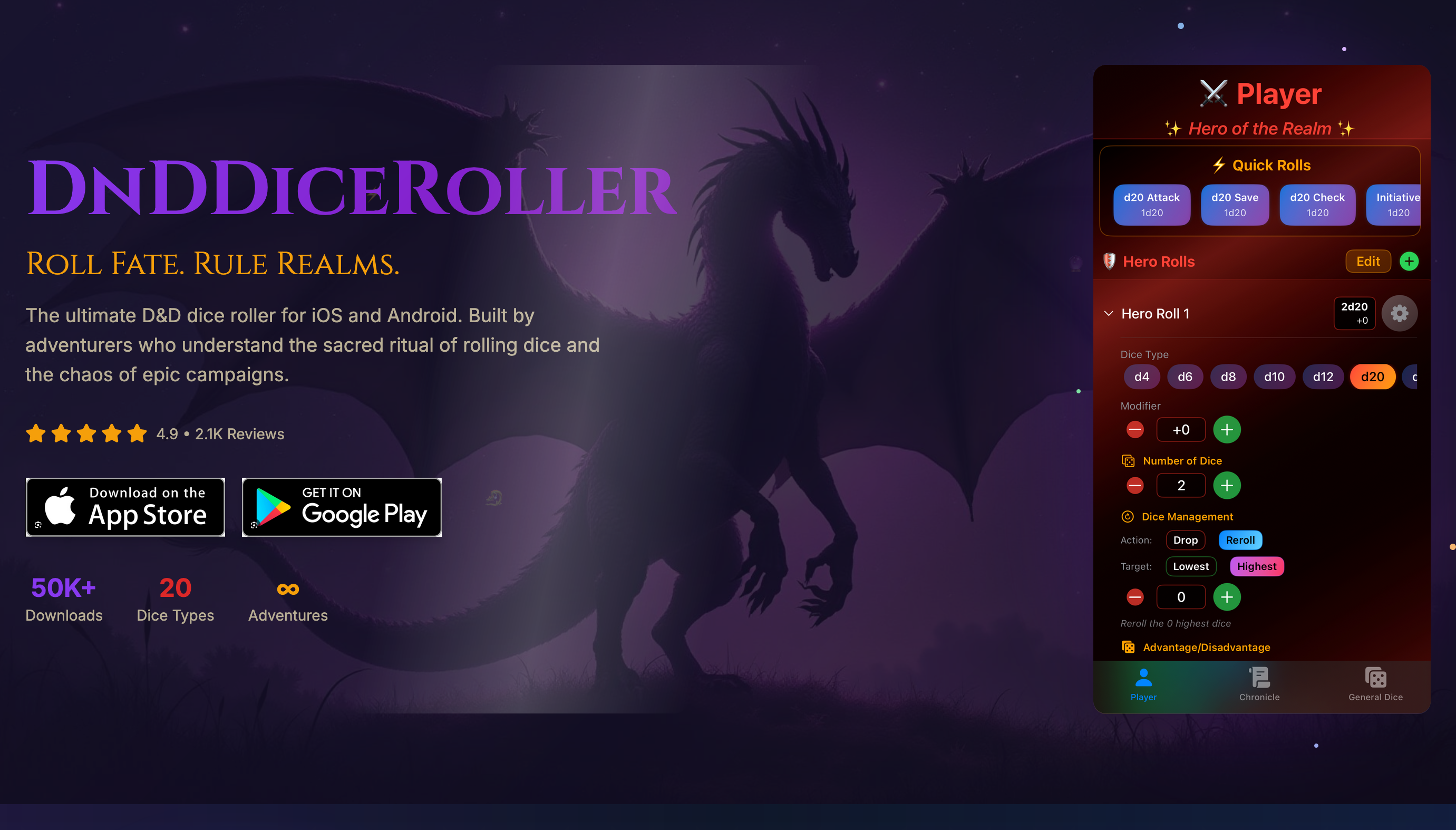
Modern dice rollers (like Legend Roller) support advanced mechanics:
Keep Highest (kh):
- 2d20kh1 = Roll 2d20, keep highest (Advantage)
- 4d6kh3 = Roll 4d6, keep highest 3 (stat generation)
Keep Lowest (kl):
- 2d20kl1 = Roll 2d20, keep lowest (Disadvantage)
Drop Highest (dh):
- 4d6dh1 = Roll 4d6, drop highest 1
Drop Lowest (dl):
- 4d6dl1 = Roll 4d6, drop lowest 1 (common stat rolling method)
Exploding Dice
Some homebrew systems and certain published adventures use "exploding dice":
- When you roll max value, roll again and add
- Potentially infinite chain
- Creates dramatic, swingy results
- Example: 1d6 exploding = 6, 6, 6, 4 = 22 damage!
Damage Types and Resistance
Different damage types matter:
Physical:
- Bludgeoning (clubs, hammers)
- Piercing (arrows, rapiers)
- Slashing (swords, axes)
Magical:
- Acid, Cold, Fire, Lightning, Thunder
- Force, Necrotic, Radiant, Poison, Psychic
Resistance/Vulnerability:
- Resistance = Half damage (rounded down)
- Vulnerability = Double damage
- Immunity = Zero damage
Dice Rolling Etiquette
The Honor System
- Roll in view of everyone
- Don't pick up the die before results are announced
- Accept your rolls with grace (no "that didn't count!")
Digital Rolling
When using digital rollers:
- Share the results immediately
- Don't cherry-pick or re-roll without announcement
- Consider everyone's comfort level with digital vs physical
DM Discretion
- The DM has final say on any roll
- Sometimes DMs roll secretly
- Trust your DM's judgment on contested rolls
Common Rolling Scenarios
Attack Sequence:
- Roll 1d20 + attack modifier
- Compare to target's AC
- If hit: Roll damage dice + damage modifier
- Apply any resistance/vulnerability
- DM narrates the result
Saving Throw:
- DM calls for a save and announces DC
- Roll 1d20 + relevant save modifier
- Compare to DC
- Success = half damage or avoid effect
- Failure = full damage or suffer effect
Ability Check:
- Declare what you're attempting
- DM sets DC (or tells you to roll)
- Roll 1d20 + relevant skill/ability modifier
- DM narrates success or failure
Pro Tips for Better Rolling
-
Announce Before Rolling: Say what you're doing before rolling. "I'm attacking the goblin" not "I rolled a 15!"
-
Calculate Modifiers Ahead: Know your +to hit and damage before your turn
-
Respect the Dice: Even digital rolling deserves ceremony and respect
-
Learn Probabilities: Understanding probability makes you a better player
- 50% chance to hit AC 11 with +0 modifier
- Advantage roughly equals +5 to your roll
- Disadvantage roughly equals -5 to your roll
-
Narrate Your Rolls: Make them exciting! "I swing my greataxe in a wide arc!" is better than "I attack."
Conclusion
Dice rolling is both science and art in DnD. The math is simple, but the impact is profound. Every roll is a story moment, a chance for triumph or disaster.
Whether you're rolling physical dice or using a digital roller like Legend Roller, embrace the randomness. The click-clack of dice (real or digital) is the soundtrack to epic adventures.
May your rolls be blessed, your crits be frequent, and your fumbles be memorable.
© 2026 Iron Code Studios